Minneapolis Industrial Real Estate: Market Report
July 24, 2026 · By Cody Leivas · Minneapolis market
Minneapolis–St. Paul costs more than most Midwest industrial markets, and most buyers stop reading right there. We keep reading. Behind the higher pricing sits a $101,000 median household income, 17 Fortune 500 headquarters, and one of the most diversified tenant bases in the region (CoStar, Q1 2026). Here’s what you’re seeing: the Twin Cities market isn’t cheap, it’s durable. For a basis-driven buyer, the work is finding the functional small-bay where in-place rents still lag market — not chasing the big bulk that sets the headline.
The numbers
Twin Cities industrial inventory is roughly 439 million square feet across about 10,070 buildings (CoStar, Q1 2026). Vacancy sits near 4.3%, with availability (space marketed but not yet empty) around 7.0%. Asking rents run about $9.57 per square foot, with triple-net rents near $8.11 and year-over-year rent growth of roughly 3.4% (CoStar, Q1 2026). Over the past five years asking rents climbed from about $7.03 to $9.57, a gain near 36% (CoStar, 2021 Q1–2026 Q1). The reason is simple: demand keeps showing up and not much new small-bay gets built.
Net absorption ran positive at roughly 647,000 square feet over the trailing twelve months, against about 6.7 million square feet under construction (CoStar, Q1 2026). What you’re seeing is a market leasing space steadily while a manageable pipeline delivers — not the overbuild that has pressured faster-growing Sun Belt metros.
Why the basis still works at a premium
Sale pricing in Minneapolis sits near $106 per square foot at a market cap rate around 8.8% (CoStar, Q1 2026). That’s firmer than St. Louis or Cleveland, and here’s the reason: deep tenancy, high incomes, and a core where there’s barely any land left to build more. So the below-replacement thesis here is narrower than in a cheaper market, and we underwrite it that way.
Buy functional small-bay below replacement cost, where in-place rents lag a market that has climbed from $7.03 to $9.57/SF since 2021 (CoStar, Q1 2026). The return comes from closing the in-place-to-market rent gap on renewal — not from cap-rate compression off an 8.8% market rate.
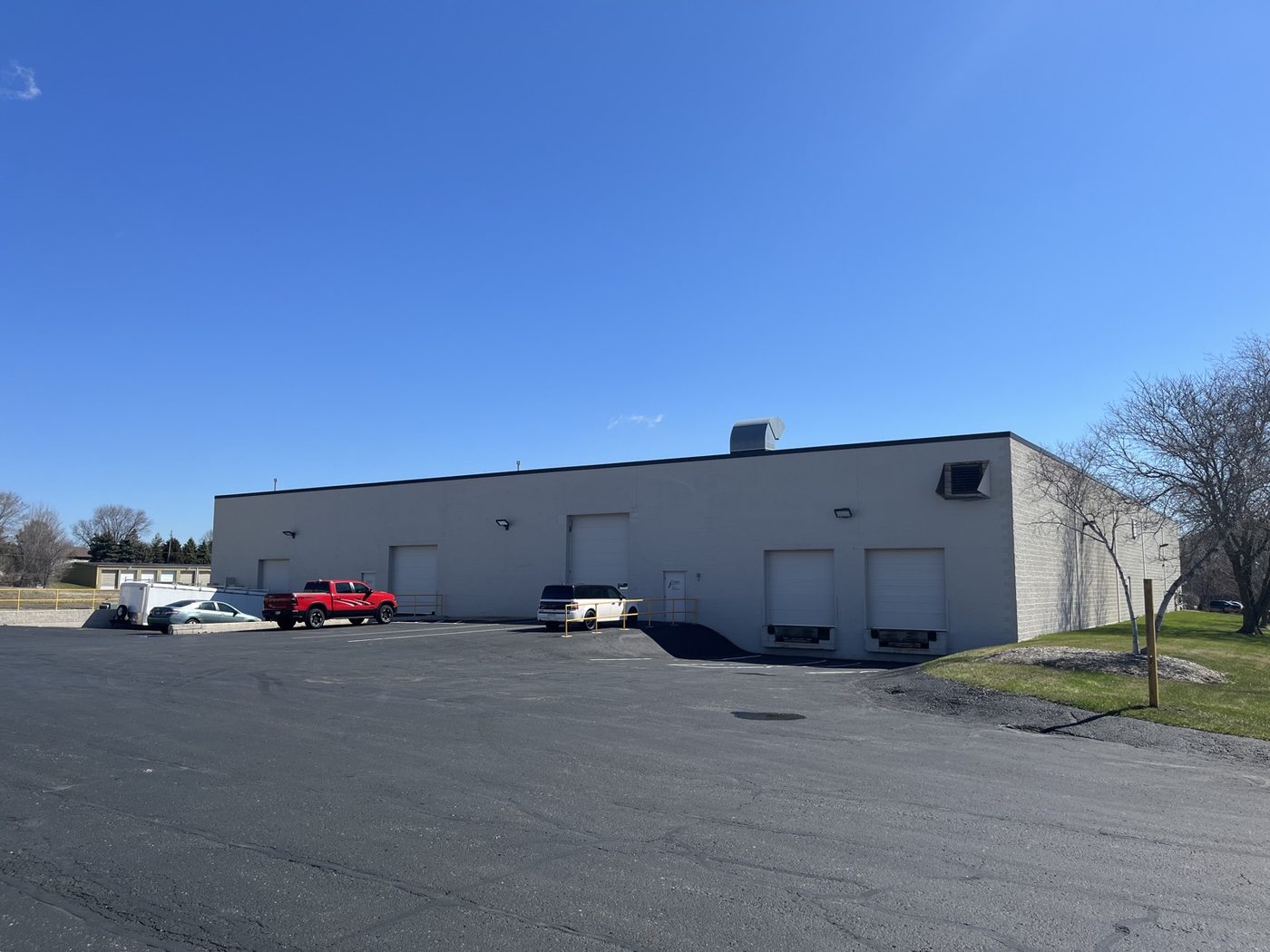
The opportunity sits in one segment. Developers build large modern bulk, because that’s what their models underwrite. They don’t add 20,000-to-60,000-square-foot multi-tenant buildings at today’s land and construction costs. That leaves functional small-bay priced below what it would cost to replace, with in-place rents that lag where a renewal would clear. The gap between in-place and market rent is the lever — not a bet on cap rates falling. We’re not underwriting to a big exit. We’re underwriting to a basis that holds up even if pricing stays flat. The basis protects us.
Submarkets we watch
- Northwest / Maple Grove — an established distribution and light-manufacturing corridor along I-94, with sticky local tenants and little new small-bay supply.
- Southwest / Shakopee — the metro’s main modern bulk growth path, where most of the new pipeline has landed; we watch it for pricing signals more than for our own product.
- Northeast / I-35W — older infill manufacturing and flex stock close to labor, where functional buildings stay occupied through cycles.
- East / Woodbury — the St. Paul side, with steady single-tenant and flex demand serving the eastern metro and western Wisconsin.
Demand drivers
Minneapolis runs on a spread of industries, not a single freight story. Seventeen Fortune 500 companies are headquartered here, and the tenant base shows it: medical-device manufacturing anchored by Medtronic, retail and distribution led by Target, advanced materials and manufacturing at 3M, food processing across a dense regional cluster, and e-commerce logistics from Amazon (CoStar / company filings, 2026). Industrial employment runs near 295,000 in a metro of about 3.8 million people (CoStar, Q1 2026).
That spread is the point. A market leaning on one tenant type takes the full hit when that sector turns. Minneapolis spreads its demand across medical, food, retail, materials, and logistics — so no single downturn empties the small-bay we focus on. For the broader regional thesis, see our Midwest industrial market guide and the rest of our market reports.
How Bluebird approaches the market
We underwrite Minneapolis on in-place versus market rent, lease structure and rollover, submarket vacancy, and a conservative capital stack — then push income through leasing, mark-to-market on renewal, and disciplined operations. Our edge is operational, not financial engineering. In a market priced for quality, the discipline is paying for what the in-place income supports, not for a growth story we have to invent. You’d have to prove that growth out, and we won’t pay for it up front. More detail is on our Minneapolis market page.
The Twin Cities won’t be the cheapest entry in our footprint, and we don’t pretend otherwise. What they offer is durability — a diversified, high-income economy where functional industrial space stays leased and rents grind higher over time. To me, that’s exactly the kind of exposure accredited investors should want in the patient part of a portfolio. Targeted outcomes are not guarantees.
Market statistics above are drawn from third-party sources believed reliable and are provided for informational purposes only; they are not a guarantee of future results. Bluebird works with accredited investors — request access to learn more.

Cody Leivas · Principal & Managing Partner, Bluebird CRE
Principal & Managing Partner at Bluebird CRE, where he underwrites and operates value-add Midwest industrial real estate. He holds a Master of Science in Real Estate (Chapman) and a Master of Investment Management & Financial Analysis (Creighton), with involvement in $750M+ of commercial transactions. More from Cody
Start a conversation to learn how we acquire Midwest industrial. Start a conversation