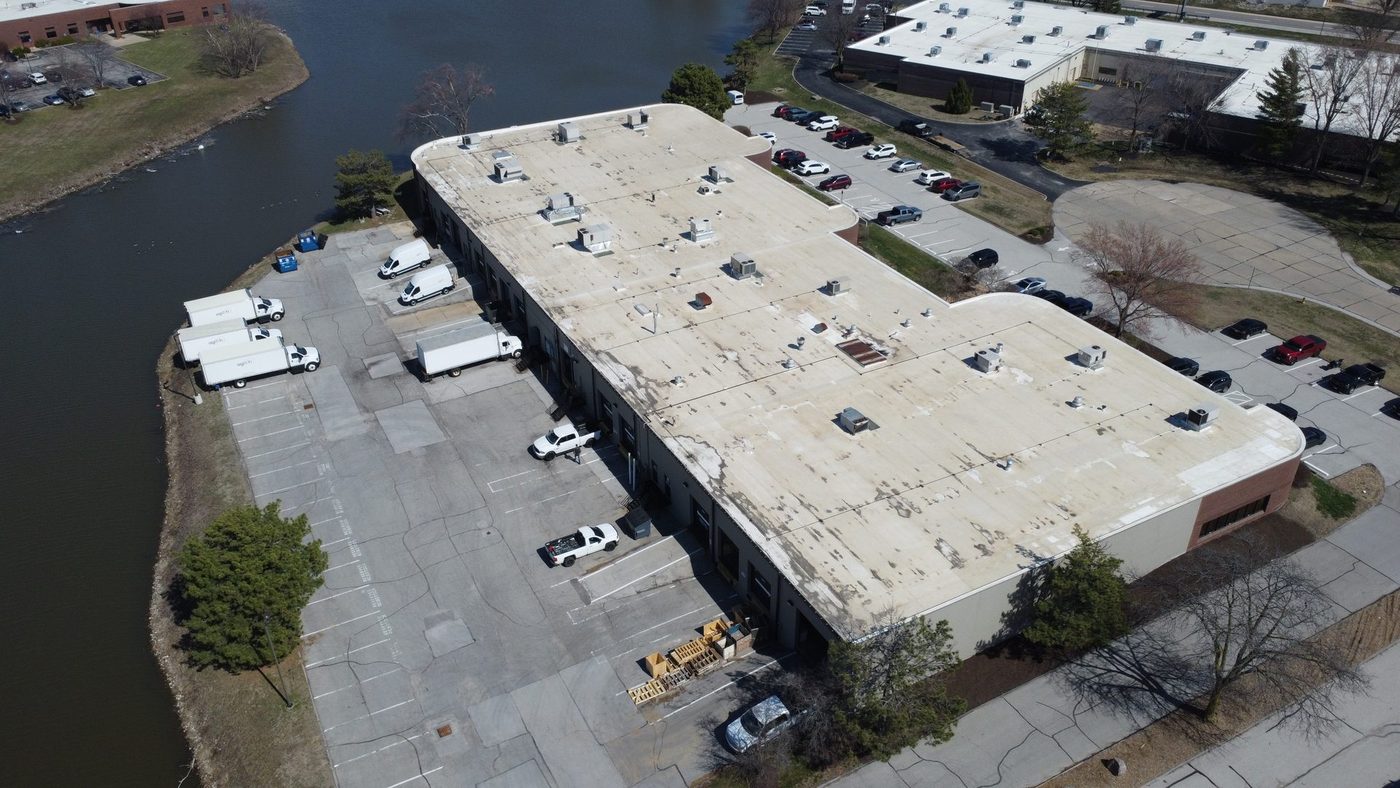
St. Louis Industrial Real Estate: Market Report
July 10, 2026 · By Cody Leivas · St. Louis market
St. Louis posted negative net absorption of roughly 2.9 million square feet over the trailing twelve months (CoStar, Q1 2026). The headline reads like weakness. To us it’s a sorting. Here’s the reason: the giveback sits in big-box space, while the small-bay buildings we own and chase along the I-70 corridor stay tight and price below what it costs to build new. This is a split market, and the split is the opportunity.
St. Louis industrial trades near $70/SF (CoStar, Q1 2026), well below the cost to build the same building new. Buy occupied small-bay below replacement, and the basis holds the downside whether or not rents run.
The numbers
St. Louis industrial inventory spans roughly 345 million square feet across about 7,790 buildings (CoStar, Q1 2026). Vacancy sits near 5.4%, and availability (space marketed but not yet empty) runs 7.3%. Average asking rents are around $7.42 per square foot, with triple-net rents near $6.27 and rent growth of about 3.5% year over year (CoStar, Q1 2026). Over the past five years asking rents have climbed from roughly $5.84 to $7.42, a gain near 27% (CoStar, 2021 Q1–2026 Q1). Rents grind higher because nobody’s adding cheap space.
The market cap rate sits near 8.8% with sale pricing around $70 per square foot (CoStar, Q1 2026). That last number is the one to watch. Building new runs well above $70 a foot once you add up land, shell, and tenant improvements. When you can buy occupied buildings below what it costs to build them, your downside rests on the math, not on hope.
Reading the negative absorption
Negative absorption scares people who treat industrial as one thing. It isn’t. The roughly 4.1 million square feet under construction here is mostly big speculative box (CoStar, Q1 2026), and that’s where the softness sits. Net deliveries actually ran slightly negative over the trailing year, meaning teardowns and conversions outpaced new buildings in parts of the stock.
Small-bay and flex space (15,000 to 60,000 square feet, the buildings local manufacturers and distributors actually use) tells a different story. Speculative supply doesn’t land there, because developers build big box. So you get a real shortage of exactly the buildings we focus on. The headline vacancy number averages the two together and hides both.
Why the basis matters
The most important fact about St. Louis is the gap between in-place rents and the cost of new supply. When those two numbers split apart, two things happen over time. Existing rents pull toward the cost to build new, and the downside gets cushioned because no developer adds competing small-bay space at a loss.
That’s the whole thesis behind a below-replacement basis. It’s not a bet on rent spikes or cap rates falling. It’s a bet that steady demand plus tight small-bay supply slowly closes the gap between what a building rents for today and what it would cost to replace. We’re not underwriting to a heroic exit. We’re underwriting to a basis that makes sense even if nothing exciting happens.
Submarkets we watch
- Earth City / Riverport — the dense logistics core inside the I-270 / I-70 loop, with Missouri River access and sticky distribution tenancy. Central to our footprint.
- Hazelwood / I-270 — functional infill near the airport and the interstate ring, with steady single-tenant and flex demand.
- Edwardsville (Metro East) — the Illinois side, where larger modern bulk product has clustered along I-55/I-70.
- Westport — established inner-ring flex and light-industrial with durable local occupancy.
Demand drivers
St. Louis is a central-U.S. shipping hub. It sits on the nation’s second-largest inland port by trip-ton-miles, carries two Class I railroads, and anchors the I-70, I-44, I-55, and I-64 crossroads. That location supports a wide tenant base across manufacturing, defense, e-commerce, and auto supply. Boeing Defense, World Wide Technology, Amazon, and GM’s Wentzville assembly plant all operate here. When tenants come from that many directions, you’re not leaning on one industry to fill your buildings.
Industrial employment runs near 194,000 in a metro of about 2.8 million people (CoStar, Q1 2026). That manufacturing depth, paired with build costs above sale prices, keeps the basis attractive for buyers willing to do the work. For the broader regional read, see our Midwest industrial market guide and the rest of our market reports.
How Bluebird approaches the market
We underwrite St. Louis on in-place versus market rent, lease structure and rollover, submarket vacancy, and a conservative capital stack — then push income through leasing, mark-to-market on renewal, and steady operations. Our edge is operational, not financial engineering. Several of our Missouri buildings sit in these submarkets, including the Earth City and Dielman corridors. More detail is on our St. Louis market page.
The opportunity here isn’t glamorous. It’s a patient, basis-driven play in plain buildings that real businesses need, in a market where the headline numbers scare off buyers who don’t separate big box from small-bay. To us, that’s exactly what makes it attractive for accredited investors who want steady industrial exposure. Low basis. Tight small-bay supply. Rents with room to run. Targeted outcomes are not guarantees.
Market statistics above are drawn from third-party sources believed reliable and are provided for informational purposes only; they are not a guarantee of future results. Bluebird works with accredited investors — request access to learn more.

Cody Leivas · Principal & Managing Partner, Bluebird CRE
Principal & Managing Partner at Bluebird CRE, where he underwrites and operates value-add Midwest industrial real estate. He holds a Master of Science in Real Estate (Chapman) and a Master of Investment Management & Financial Analysis (Creighton), with involvement in $750M+ of commercial transactions. More from Cody
Start a conversation to learn how we acquire Midwest industrial. Start a conversation